No account · No cloud · No watermark
A scanner with nothing to hide.
Scan, straighten, sign and recognise the text of your documents on your Android phone. Everything runs on the device and nothing is uploaded to a server to be processed.
Get it on Google Play free · Android 8+Pro: one payment of USD 4.99, forever. No subscription.
Missing your old scanner?
Whiteboards, business cards, read aloud, tables. Offline.
The free scanner that did all of this was retired in March 2026, and its replacements dropped the parts people used most. Pila has them, and none of it leaves your phone.
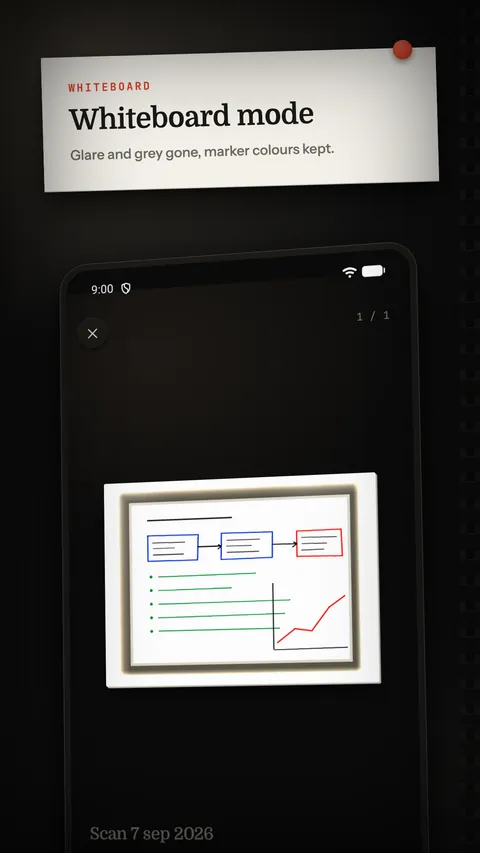
Reflections gone, marker colours kept
Point the camera at a whiteboard. Pila divides out the glare and the grey and leaves the blue, red and green strokes as they were.
Straight into Contacts
Recognise a card and Contacts opens with the name, phone, email and company already filled in. No permission needed.
Listen to any page
The recognised text is read with the phone's own voice. Useful for long letters, useful for tired eyes.
Receipts to Excel
Lines that share a row and a column become a table. Copy it, or save it as an .xlsx that opens in Excel, Sheets and LibreOffice.
Text to a .docx
Any recognised page can be saved as a Word document, paragraph by paragraph, without a library and without the cloud.
Latin, Chinese, Japanese, Korean, Devanagari
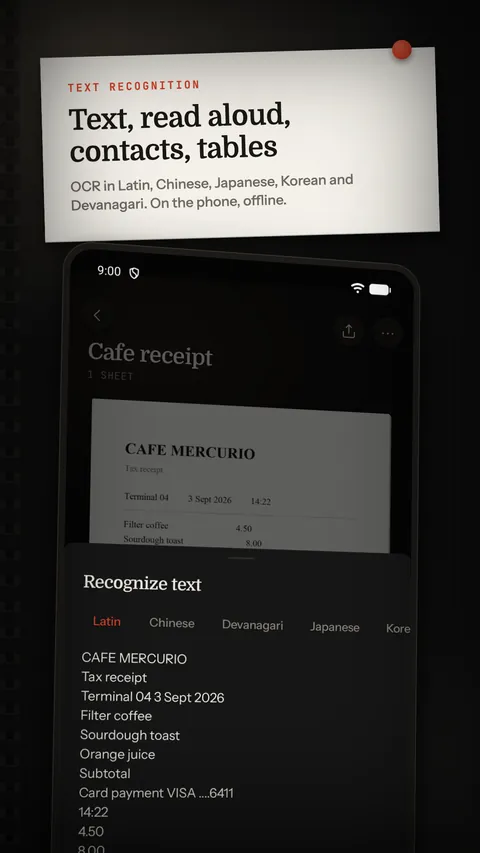
The recognition models ship inside the app. Pick the script by hand when a document is not in your phone's language.
The app
A dark desk, sheets of paper, one lamp.
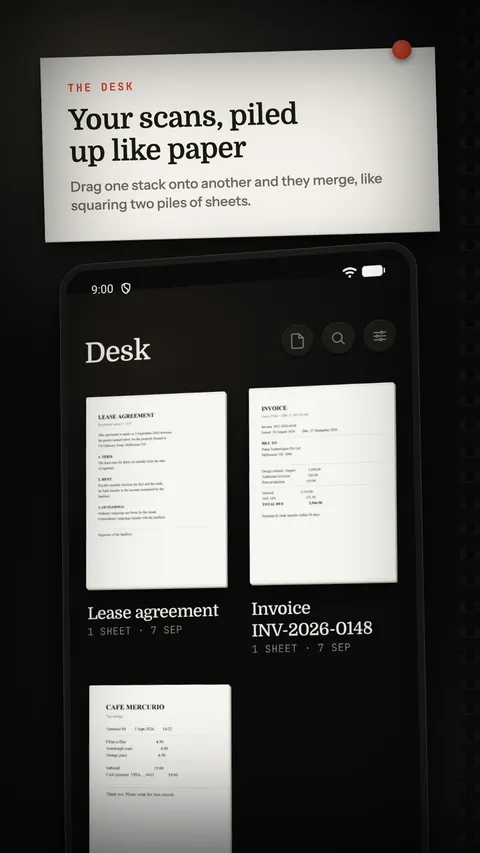
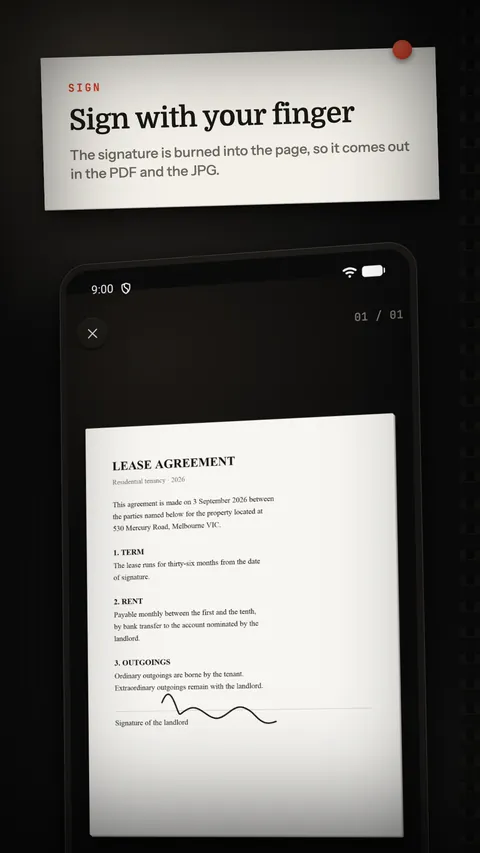
This is what Pila looks like. The screenshots are the ones from the Google Play listing, in each of the 13 languages.
Everything else
A desk, not a folder tree.
Your scans sit on a dark desk as stacks of paper. Drag one stack onto another and they merge, the way you square up two piles of sheets. Reorder sheets by dragging them.
- Scan with edge detection and perspective correction, up to 50 sheets at a time. Straighten by hand when the camera gets it wrong.
- Filters made for paper. Original, Paper, High contrast, Whiteboard, and a black-and-white mode with an adaptive threshold: a shadow no longer becomes a black patch.
- Sign with your finger, anywhere on the page. The signature is burned in at full resolution, so it comes out in the PDF and in the images.
- Searchable PDFs. Once a page has been recognised, the text sits invisibly under the image. Any viewer finds it and selects it.
- Search the desk by stack name or by the text on your sheets, accents ignored.
- Import photos and PDFs, or share them to Pila from any app. PDF pages become sheets and go through the same review as a scan.
- ID card mode: front and back on one A4 page, the way a photocopier would do it.
- App lock with your fingerprint, face or screen lock, and password-protected PDFs for the one that has to leave the phone.
- A backup you own. Export everything to a zip, keep it wherever you like, restore it on the next phone. Restoring adds what is missing and never overwrites.
- 13 languages, right-to-left Arabic included, a home-screen widget and a shortcut that open the scanner directly.
Private by design
Nothing leaves your phone. And you can check.
No account, no cloud
There is no sign-up and no sign-in. Scans live in the app's private storage and go away with the uninstall.
Recognition runs here
Edges, straightening and OCR happen on the device. No image and no text is uploaded to be processed.
They leave only when you say so
A document leaves the phone only when you export or share it, and it goes exactly where you send it.
- Declared permissions
- INTERNET · ACCESS_NETWORK_STATE (ads and billing) · BILLING · AD_ID
- Camera permission
- None. Capture is handled by the ML Kit activity
- Storage permission
- None. Exports go through MediaStore and the system share sheet
- This website
- No cookies, no analytics, no third parties. The fonts live here
Pricing
Free does everything. Pro removes the friction.
The free plan has no watermark and no limits on scanning, filters, import, search, lock, password or backup. Text recognition costs one short ad per use.
Pila Pro
No ads. Unlimited text recognition, with every new sheet recognised in the background. Signatures. Full-resolution export. One payment, and it stays yours.
- No ads
- Unlimited OCR
- Automatic OCR
- Signature
- Full resolution
The price is shown in your currency inside Google Play. Purchases are handled by Google Play Billing: Pila never sees your payment details.
How it compares
What the others charge for, or send to a server.
| Pila | Others |
|---|---|
| No account | Some scanners will not scan a page without signing in. |
| No cloud | Several upload your documents by default, to servers you did not choose. |
| No watermark | Others stamp their name on every free export. |
| USD 4.99 once | USD 40 to 80 a year for text recognition elsewhere. |
| Whiteboard, cards, read aloud, tables | The one free app that had them was retired in 2026. |
| Password, lock and backup included | Usually behind the subscription, or not there at all. |
Questions
What people ask before installing.
Do I need internet to use Pila?
No. Scanning, straightening, filters, signing, text recognition and export all work offline. The connection is used only for the ads in the free plan and for buying Pro through Google Play.
Where are my documents kept?
In the app's private storage, on your phone. No other app reads them and there is no copy on any server. If you uninstall Pila they are deleted with it. To keep them, export a backup from Settings.
What happens when I change phones?
Export a backup, a zip file, and keep it wherever you like: Downloads, a pen drive or your own cloud. On the new phone, restore it from Settings. Restoring adds the stacks that are missing and never overwrites the ones already there.
Is Pro a subscription?
No. It is a one-time payment of USD 4.99, in your currency inside Google Play. It is tied to your Google Play account and can be restored on any phone that uses the same account.
Does it recognise text in my language?
The models for Latin, Chinese, Japanese, Korean and Devanagari scripts ship inside the app. Each of them also reads Latin. Arabic has no recognition model yet, although the interface is available in Arabic.